7/17/17

A look at Graphic Novels

I just completed a Graphic Novels course for my MLIS at San Jose State University's iSchool for which I read 10 graphic novels. For each novel, I wrote an annotation and decided to share this information here. Below I have included my entire paper. Feel free to read it if you like.


I summarize the following ten novels (not in order):

  1. American Born Chinese by Gene Luen Yang
  2. A Contract with God by Will Eisner
  3. Maus by Art Spiegelman
  4. Persepolis by Marjane Satrapi
  5. March: Book One by John Lewis
  6. Safe Area Gorazde by Joe Sacco
  7. The Arrival by Shaun Tan
  8. The Property by Rutu Modan
  9. Ms. Marvel: No Normal by G. Willow Wilson
  10. All-Star Superman Complete by Grant Morrison
The Arrival
From Goodreads
Tan, S. (2006). The arrival. New York: Arthur A. Levine Books.
Shaun Tan’s The Arrival is a brilliant wordless graphic novel sharing the tale of an immigrant in his new city after leaving his wife and daughter. Each panel shares the struggles of going to a new and strange world. The wordless nature brings attention to the fact that everyone speaks a different language, and yet they still can communicate. The communication takes place with drawings and gestures. Each new person which the immigrant meets has a unique story to tell of why they are in their new land. The story has strange animals and sights giving the world an unfamiliar feeling drawing readers into the story. Tan uses double-page spreads to tell his story, even having panels crossover both pages instead of the traditional single page spreads to tell his story. This book is a marvelous example of what a graphic novel can do using simple images. Tan’s book should be part of graphic novel canon and I would recommend the book to anyone interested in seeing the life of immigrants. This book is unique in that it is wordless but the fact that it is wordless adds to the beauty of the book and the story. Even without words readers are engaged and can understand what the characters are feeling. Tan’s book is a must read for anyone who enjoys graphic novels.

Maus
From Goodreads
 Spiegelman, A. (1986). Maus: A survivor’s tale: My father bleeds history. New York: Pantheon Books.
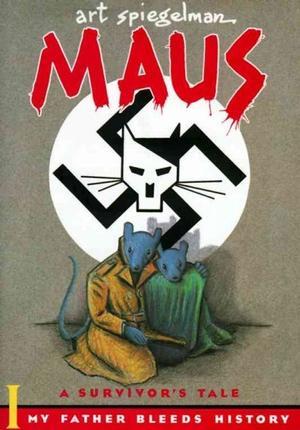
In Maus Spiegelman tells his father’s sad and moving story of surviving the Holocaust as a Polish Jew. Spiegelman uses animals to depict the characters in his narrative: Jews are mice (maus in German), Poles are pigs, and Germans are cats. This is fitting because just as cats hunt mice, the Germans were hunting the Jews. Maus is divided into six chapters, each telling one part of Vladeck (father) and Anja’s story. Each of these chapters has a skillfully drawn cover image with the title displayed. Maus shares not only Vladek’s story of how he and Anja survived WWII by hiding from the Gestapo but also the interactions of Vladeck and Arti (Spiegelman) while Spiegelman was recording the story for the book. The interjections share life as it is now, after the war, after Anja died, and after Art had grown and was living on his own. While the first narrative is heavy and dark, both in style and content, the second has elements of humor and levity. Spiegelman adds a third narrative into the story in Chapter 5 about his mother’s suicide and the effect it had on the family. These pages use dark backgrounds and more deliberate shading, also while the rest of the book uses animals to tell the story this inset uses people to share Anja’s story. Maus is a good read for those interested in learning about the effects of WWII from a Jewish perspective. Maus is a great addition to any graphic novel collection adding historic elements to the canon

Ms. Marvel: No Normal
From Goodreads
Wilson, G. W., and Alphona, A. (2015). Ms. Marvel: No normal. New York: Marvel.
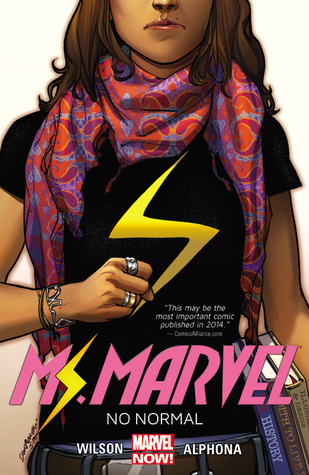
            Ms. Marvel tells the story of Kamala, a Pakistani-American teen, trying to discover herself. Wilson’s writing is fast paced and exciting, pairing wonderfully with Alphona’s vibrant illustrations. Together they create a world where anything is possible if you believe; the way they create Kamala allows readers to understand and connect with her, making you believe everything that comes to pass. Kamala struggles with trying to be herself, which is difficult because she wishes to have her own way but must follow the strict religious and social boundaries established by her parents. Each section begins with a full-page image of Kamala as she masters her new-found powers.  Different sized panels tell the story, some panels are small insets within larger images, while other take up whole pages. The panels are arranged in a traditional manner, with some overlapping one another or covering the entire page width. Yellow text bubbles allow readers to view character’s thoughts and provide an internal narrative for the characters helping readers understand why they do something. Ms. Marvel is a well-written origin story with skillfully drawn images. Kamala like other heroes has a friend who she tells about her powers, but will not tell her family. Ms. Marvel provides a modern look at who can be a superhero by giving the graphic novel canon a new fresh image for female superheroes.

American Born Chinese
From Goodreads
 Yang, G. L. (2006). American born Chinese. New York: First Second Books.
            Yang’s beautifully illustrated volume tells the stories of Jin Wang, Danny, and the Monkey King. Jin is a young Chinese-American boy trying to fit in with his new classmates but is always reminded of being the outsider. While Danny is a teenage boy who has just begun to fit in at his new school (the third in three years), until his cousin, Chin-Kee, shows up. While Jin feels that he does not fit in Danny is embarrassed by his cousin and feels that everyone makes fun of him not because of who he is but who his cousin is. The final story is that of the Monkey King. Monkey desires to become a god, mastering all twelve aspects of Kung Fu to become immortal. In all three stories, the characters must learn the same lesson, to be themselves. Yang’s colorful illustrations accompany each story, all three stories are told in a similar style. The story of Chin-Kee has a unique feature, at the bottom of some panels Yang has placed the words “HA HA HA” or “CLAP” in bubble letters, this indicates to the readers the embarrassment Danny feels around his cousin. The words add a sense of uneasiness to the frames. Yang also uses slanted gutters which cut diagonally across the panels adding a sense of movement to the scenes not accomplished by traditional gutters. American Born Chinese is a fascinating read for anyone who feels out of place. The graphic novel belongs in the cannon and helps readers learn to be themselves.


March
From Goodreads

        Lewis, J., Aydin, A., and Powel, N. (2013). March: Book one.    Marietta, GA: Top Shelf Productions.
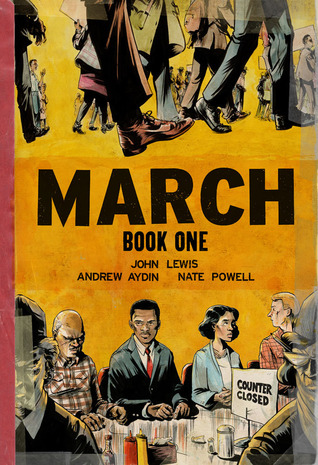
March: Book One is written by John Lewis and reflects on his work during the Civil Rights Movement. Lewis shares his experiences in a flashback tale with two boys and their mother on the day of President Obama’s inauguration. The first story Lewis shares is about how he grew up on a farm helping raise the chickens, in this story we see his compassion and humanity. The second story tells of how Lewis gained interest in helping African-Americans gain equality and justice. He tells of how his favorite uncle arranged for him to take a trip to the North for the summer, where he saw the difference in how African-Americans were treated there. The reader is shown how Lewis joined the movement and met Dr. Martin Luther King because of a desire to help desegregate a university near his home. While that did not happen John Lewis would become an integral part of the sit-in in Nashville as a member of The Nashville Student Movement. The black and white drawings bring a somber tone, showing the importance of what was taking place during the Civil Rights Movement. Each panel deliberately shows emotions of the characters in the story. The panels are unique with some having only two borders with others having no borders. These different shaped panels add to the story and show the passage of time or action. The novel belongs in the canon playing an important part in telling the history of the American Civil Rights Movement.

A Contract with God
Eisner, W. (2006). A contract with God: A novel. New York: W.W. Norton.
From Goodreads
            In this graphic novel, Will Eisner tells four gritty real-to-life stories about living in the tenements of the Bronx. The first story is where the book receives its name, in this tale Frimme Hersh believes he has a contract with God entitling him to only receive good things. When he loses Rachel, his daughter, he breaks this contract and his life seemingly improves. However, in the end, only God benefits. The second story, “The Street Singer,” recounts a possible life of one of many men who sang in the alleys for money during the great depression. “The Supper” details the sad life and death of the building Super, Mr. Scuggs. Mr. Scuggs is feared and ultimately this (and his lust for women) leads to his suicide. The final section, “Cookalein,” tells the devastating stories of a family, a woman, and a man. The family has problems, notably, the father has a mistress. The woman, Goldie, seeks a husband only to be tricked and rapped, by the man, Benny. These sad tales show the reality of living in a tenement, like the one at 55 Dropsie Avenue. Eisner employs many different types of panels, often without borders or set gutters. The images and words run together to tell the flowing stories. The dark ink lines share the grim stories in a beautiful way. As what is considered the first graphic novel A Contract with God gives readers a glimpse into the beginnings of the medium.

All-Star Superman
From Goodreads
 Morrison, G., and Quitely, F. (2011). All-star Superman [Digital Edition]. New York: DC Comics. Retrieved from https://www.hoopladigital.com/play/11356792
            In All-Star Superman readers are introduced to the “human” side of Superman seeing his mortality. Morrison’s reimagined Superman is powerful and compassionate. The twelve-episode story tells how Superman is dying from solar poisoning. Lex Luthor is the cause of all the trouble for both Earth and Superman because he does not want to die for the crimes he committed. The story explores what a world without Superman would look like and how he might save himself. Each story adds to the life he led as Clark Kent and Superman. Quitely’s art is vibrant and action filled, enhancing the story told by Morrison. Each panel is skillfully drawn to engage the reader with the story. The first three stories each have small inset panels to begin the episode, while the remaining nine only have the full-page images. One unique panel set is in Episode 5 where the bottom middle panels open into the gutter creating a background. This overlap into the gutter creates a larger flow for the characters in the jail scene and readers feel as if they are part of the crowd. All-Star Superman is an exciting twelve-part adventure with Superman and those he meets. The story is well told and even those who do not know the origin story can relate to it, feeling attached to the characters. The art adds to this attachment allowing readers to use closure to fill in many gaps and enhance the story. This graphic novel provides the cannon with a delightful superhero adventure.

Persepolis
From Goodreads
 Satrapi, M. (2003). Persepolis: The story of a childhood. (M. Rippa and B. Ferris, Trans.) New York: Pantheon.
            This graphic memoir shares Satrapi’s story of growing up during the time of unrest in her homeland. The dark ink illustrations show the mood of the time, fear. Each panel is filled with suspense and secrecy. Satrapi relies on closure from the readers to keep the story moving and to fill in the more gruesome details. The text tells the story in both word bubbles and text boxes along the top and bottom of panels. Though only 153 pages long this book spans many years and difficulties for Satrapi, her family, and her friends. Each chapter opens memories of darker times starting with the Revolt and ending with Marji leaving for Austria alone. The graphic novel shares the poverty, fear, massacres, and danger facing the people of Iran during the change in power from the King to the Shah and finally the Islamic Republic. The author shares how the media would twist stories to try and gain the people's trust all while the government was killing their own people who disagreed with them. Persepolis tells an important part of history and helps those who are not familiar with the fight in Iran/Middle East better understand what the people are struggling with every day. This graphic novel also is relatable to many people, because Marji is a typical rebellious teenager, making her a familiar and accessible character. The sad truth of the story is seen in most chapters making the content difficult to read at times but important to understand. Persepolis is a well written and illustrated memoir which belongs in the cannon of great graphic novels.

The Property
From Goodreads
 Modan, R. (2013). The property. (J. Cohen, Trans.). New York: Drawn & Quarterly.
            The Property tells the story of a grandmother and granddaughter who return to Warsaw in search of their property. The vibrant colors of the illustrations dramatize the story from the perspective of both characters drawing readers into their lives. In Warsaw, Regina seeks out an old flame, from before the war, because of a secret they share which Mica does not know. Mica meets a young man who gives tours of the Jewish section of town and begins to fall for him, even though he is not Jewish. Intermixed with these two stories is the story of Yagodnik, a family friend, who is trying to take the property for Regina’s daughter (Tzilla). The story has been translated into English but indicates which language is being spoken with the font used for the words. Hebrew is shown with all caps, while Polish is italicized, and English is in mixed (standard) type, a fourth type of speech bubble has only squiggles representing when a character is hearing an unknown language. This feature allows the readers to understand the situation from a specific character’s perspective and makes them more relatable. One unique panel sequence is during Day 3 when Mica is speaking with a lawyer and Yagodnik is speaking with Tzilla. This three-page set of panels uses a burgundy background for Mica and a basketball setting for Tzilla to show the two separate conversations. The Property is a stunning example of a historical graphic novel and provides a unique perspective on Jews returning to Poland long after World War II.

Safe Area Gorazde
From Goodreads
Sacco, J. (2000). Safe area Gorazde: The war in eastern Bosnia 1992-95. Seattle, WA: Fantagraphics Books.
            Sacco recounts his time visiting Gorazde during the Bosnian war as a journalist and the friends he makes while there. The war isolated and nearly destroyed the city of Gorazde during the heat of the war. The sad stories of the citizens are recounted in somber tones and dark black ink. The illustrations and text tell a story of the horrors seen by the survivors of the firefights with the Serbs. Sacco uses different colored gutters to show the story from his perspective (white) or that of the survivors (black). The black gutters appear to represent the dark times they have seen. Another unique feature of the graphic novel is the mix of text boxes and word bubbles to tell the story. Textboxes show the narration provided by Sacco, while bubbles show the dialogue of characters in each frame. This sad story is important for all to understand so that there is not a repeat of this horrible war. The graphic novel shows the impact that the war had on the citizens of the country and city, even after there was peace declared. The men and women represented are uncertain of their future and hope for a better life. The novel should be in the canon, even though I did not enjoy it because it tells an important story and represents a unique style and perspective.

Credits: All cover images are from Goodreads.com posts, each annotation begins with an APA citation crediting the author(s) and/or illustrator(s).

UPDATE: This blog post was edited and reposted to include credits line and correct Satrapi's name. Reformatted to include book title headings.

7/9/17

Radium Girls: Summary & Review

From Goodreads
Kate Moore’s account of the suffering of the dial painters in both Ottawa, IL and Orange, NJ is told in a colorful language with descriptive terms. The story of the Radium Girls from both plants is painted in deep strokes covering the many years of suffering which could have been prevented if only the radium companies would have acknowledged the dangers or the miracle “drug” radium.

The Radium Girls: The Dark Story of America’s Shining Women begins with the glowing new future the many young women found working for Radium Dial or United Radium. Moore’s story is framed with death, yet there is hope shone throughout by the girls that salvation would come. Each suffers from their own kind of darkness, even in the midst of their glowing lives. Moore’s account of these tragic lives gives light to a situation which was hidden from many, even the women themselves. Each story is sad with others worse than some but all having the same end, death. The girls became known as the living dead because of their fatal condition. Each woman hoped for a cure but also knew none would come.

Dial Painting
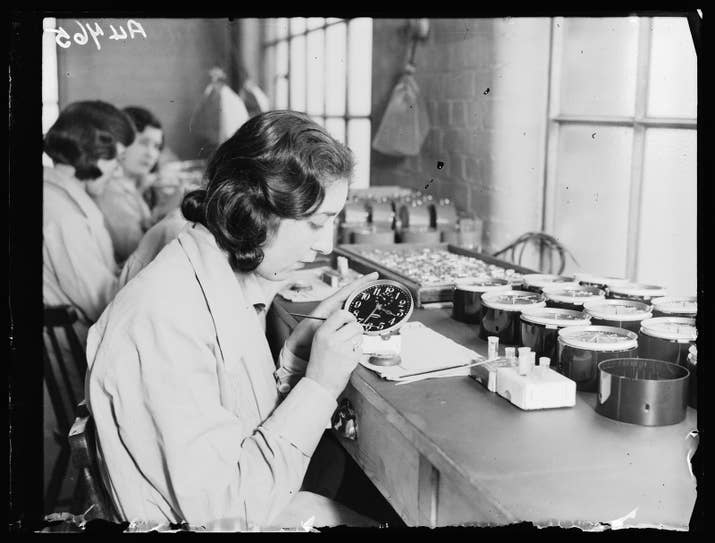
By the end of this book, I felt that I knew each of these women, partially because I am close to the same age as many of the women when the symptoms first occurred. Reading the book showed a dark era for America, even though a war had just been won and radium was raising the economy it was not to last. The story is recounted as if one is sitting listening to the tragedy unfold before one as a play (the book is influenced by one, check the Acknowledgements, pg. 405). Each of the main girls becomes a living ghost with the reader, I was often moved by their resolve to continue. If not for some of the women standing up for themselves they would never have received justice because of the denial of not only the company but the doctors, their friends, and scientist that radium was the cause. Kate Moore details the legal struggles the women went through simply to gain this justice and a bit of money to pay for their care as the radium ravaged their bodies, many died while in the midst of this fight. Reading the scenes from court brings anger and a desire for justice.
Marie Rossiter (Left), Catherine Donohoe (Center), and Charlotte Purcell (Right)

This book is a must read for those interested in learning the history of American industry and for anyone who enjoys learning of perseverance in the face of struggle. The many thousands of women depicted now have a voice and a memorial which will not be forgotten as the world moves on. Their lives led to the creation of many protections for workers, as well as scientists who work with radium, or other radioactive substances. The sad end which Moore shares for each of the girls did eventually come to light, even those who were denied justice being misdiagnosed in life. Moore includes images of the main women in her account in the center of the book, some images are even referenced in her text. In these images, they are preserved as forever young and alive untainted by the radium already present in their system. Along with the images, Moore includes her many references for each chapter at the end along with an author’s note detailing her admiration for the women and their families.

References


Moore, K. (2017). The radium girls: The dark story of America’s shining women. Naperville, IL: Sourcebooks, Inc.

Goodreads.com. (2017). The radium girls. Retrieved from https://www.goodreads.com/book/show/31409135-the-radium-girls 

Stout, S. (2010). Radium: Wonder drug to health hazard [Image of Marie, Catherine, and Charlotte]. The Times. Retrieved from http://www.mywebtimes.com/news/local/radium-wonder-drug-to-health-hazard/article_8be9d790-8321-58a2-9beb-3c66871371ac.html

Viralinside. (2017). The forgotten story of the radium girls, whose deaths saved thousands of workers’ lives [Image of Dial Painter]. Retrieved from http://viralinside.net/forgotten-story-radium-girls-whose-deaths-saved-thousands-workers-lives.html

6/11/17

The Girls of Atomic City: Revew/Summary

So, after reading Hidden Figures and seeing the movie I was interested in more women who helped with modern inventions and the war effort. In my search, I came across Denise Kiernan’s The Girls of Atomic City: The Untold Story of The Women Who Helped Win World War II. If I was hoping this was anything like Hidden Figures I was sorely mistaken. While as a work of it’s own the book is delightful and well written, it read more like a history book than a biography of the women living at Site X.

Summary

Site X was founded as part of the Manhattan Project during WWII to help build “The Gadget” which would win the war. The women who lived and worked at the site lived under constant guard and supervision so as not to reveal the secret. Each of the women met in the book knew just enough to do their job, and do it well. The Project was the nation’s largest secret and also had the largest plants and buildings of any in the world, at the time. All of this happened at Oak Ridge, Tennessee. The lives of the women changed the day they went to work for Clinton Engineer Works (CEW). They went from living very open lives to having secrets and not knowing who to trust. Each person on the Reservation (as Site X was also known) could be a spy and report any suspicious activity or loose tongue to the government. Life went on, apart from this secrecy, as normally as possible with the war. Kiernan shares the stories of nine women who worked at various jobs on the Reservation: Celia Szapka, Toni Peters, Jane Greer, Kattie Strickland, Virgina Spivey, Colleen Rowan, Dorthy Jones, Helen Hall, and Rosemary Maiers. These women range from a chemist to a cleaning woman, a nurse to a pipe checker. Each job was important and would bring about the goal of winning the war or at least completing The Gadget (Kiernan, 2013).

Video of the Author explaining her interest in the book
Denise Kiernan shares her interest in the Project and why she did it. The book was less interesting than this short video clip.


Review (Contains some spoilers, but most know the result of The Project and The Gadget)

As I said earlier the book was enjoyable but not what I had hoped for. While the title claims to be about “The Girls of Atomic City” I felt that I learned more about the city than the “girls.” Each of the stories is presented in a disjointed almost puzzled way making it easy to confuse which woman is which. Kiernan (2013) shares the lives of much more than the nine women mentioned in the introduction leading to confusion and no real connection with the characters. As an overview of life in Oak Ridge this is a good book to read, but for someone who wants to learn about women during WWII, it provides only surface information.

The book does give a feeling of secrecy, though if the reader examines the Principal Cast of Characters at the front of the book some of this is lost. The disjointedness may come from an attempt to create the partitioned type of lives the women lived, each woman was expected to keep work
Billboards like this were common in Oak Ridge
separate from social life or suffer consequences, which ranged from a stern talking to up to the loss of a job. The set up of the book is nice though I found the intermixed information specifically about Tubealloy or the Product to detract from the story though they added to the history. If I was only looking at a book for reading this would not be it, but because I enjoy history I was able to make it through.

Two of the most striking stories for me were not even about the women but two men. They did touch the life of Rosemary (the nurse) but other than casual meetings in the hospital she is not the main focus. The first was a young soldier who was kept apart because he knew too much but was mentally unstable (Kiernan, 2013). This story is never finished and what happened to him is a mystery. The result of the second is just mystifying, Kiernan (2013) explains that this is because of a lack of records on the second man or miscommunications. The second man was in an accident and badly injured but instead of receiving immediate medical aid was used to test the effects of The Product (plutonium). This story also had an unsatisfactory ending, and simply did not relate to the title.
For a book supposedly about the women of Oak Ridge, a surprising amount of space is occupied by men. I do not mind reading about men and know they did much but I picked this book because I thought it would be about the women helping build or work near the Gadget or its parts but was disappointed in it. However, the book is interesting and does shed some light, though limited, on the women of Atomic City.

Reference

Goodreads. (2017). The girls of Atomic City: The untold story of the women who helped win world war II [Image] Retrieved from https://www.goodreads.com/book/show/15801668-the-girls-of-atomic-city?ac=1&from_search=true


Kiernan, D. (2013). The girls of Atomic City: The untold story of the women who helped win World War II. New York: Touchstone Books. 

Rennawarren [User name]. (2011, June 18). We interrupt this program… [Weblog comment (billboard image)]. Retrieved from https://spaceshuttleatlantislaunch.wordpress.com/2011/06/18/we-interrupt-this-program/

Simon & Schuster Books [User name]. (2013, January 14). Denise Kiernan on the girls of Atomic City [YouTube video]. Retrieved from https://www.youtube.com/watch?v=mKYxj6n4xho

6/1/17

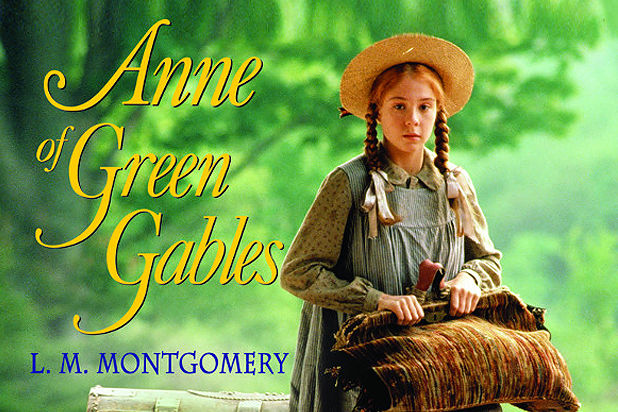
Anne of Green Gables: Blog

Anne Blog

I have recently begun watching Netflix's Original show Anne with an E and began remembering the book, this show is not for the young, but an older audience able to understand and handle the reality of the era. 

Having seen an older series series, Anne of Green Gables, I am still not thrilled by this new series (only about 3 episodes in). Anne with an E does appear to follow the book more closely, even following many of the uncomfortable content of Anne’s earlier years as a “maid” of sorts to other families.

Anne of Green Gables 
Enough about the Series, as I said I will work on a review, this post is about an old school assignment I completed for a Young Adult (YA) Literature class at SJSU. This website was created as a final project for INFO 268 in the pursuit of my MLIS.


So, on the website, I provide information about the book but that is not all, I also provide interesting background and biographical information about Anne of Green Gables.

Anne of Green Gables Website Screenshot
The blog provides a summary of the book Anne of Green Gables, along with a list of the characters present in the book. The book is actually the first in a Series about Anne of Avonlea. Under the L.M. Montgomery tab the website provides information about the author of the series.
L. M. Montgomery
The Historical/Social content explains information about when the book was set, as well as when it was written. Themes of overcoming adversity, growing up, and belonging are all discussed in brief paragraphs. The Literary Review tab has information about how Anne of Green Gables has become part of the Cannon of Sentiment. Along with sentiment, the impact of Anne globally is discussed on this page.

So, this blog post is simply about another blog I have created. To find my Anne of Green Gables website follow this link.
References
Ge, L. (2016, Jan. 12). New ‘Anne of Green Gables’ series in the works at CBC [Image]. The Wrap. Retrieved from http://www.thewrap.com/anne-of-green-gables-miniseries-in-the-works-at-cbc/

IMDb. (2017). Anne with an e [Image]. Retrieved from http://www.imdb.com/title/tt5421602/

Martin, A. (n.d.) April Martin 268 Final [Web log, Figure 1]. Retrieved from https://martin268final.wordpress.com/

Wikipedia. (2017). Lucy Maud Montgomery [Image]. Retrieved from https://en.wikipedia.org/wiki/Lucy_Maud_Montgomery

5/30/17

Another Blog: Illustrator Study

Well for most of this month I have been tied up working on final class projects. Two were blogs and the third a paper. I will be showcasing my Illustrator Study in this post. For the study, I looked at the work of two children's book author/illustrators.

I enjoyed working on the project for my Materials for Children class (INFO 263) at San Jose State University (SJSU) where I am completing my Master of Library and Information Science. I will have the degree completed, hopefully, this coming December (2017).

Blog Homepage
Retrieved from http://2017illustratorblogmartininfo263-10.weebly.com/
The above image is the first page of my project "blog" or I should say website. I provide information abut the two authors, Jan Brett and Rober Sabuda.
Screen Shot of Comparing Illustrators

Part of the Project included comparing the two illustrators styles. For this, I created the below image comparison and chart comparing their work/influences. This information is found on the website in more detail.


The above chart shows the information from the research I completed for the website and each illustrator. I found the similarities and differences fascinating. One similar influence was both were encouraged by their moms.  

This information and more can be found on the website for those who are interested in learning more about the two illustrators. Along with information about there is a brief bibliography of works for each illustrator including books written by each.

To view the whole project you can go to:

http://2017illustratorblogmartininfo263-10.weebly.com/

This will take you to the home page of my website where you can explore the information I have collected.

This is a finished project and will not be updated.

References (for the comparion chart)
Augustine, K. (2015). Stitching with paint: Inside the world of Jan Brett. Piecework, 23(5_, 16-19. Retrieved from http://libaccess.sjlibrary.org/login?url=http://search.ebscohost.com/login.aspx?direct=true&db=ofm&AN=108673068&site=ehost-live&scope=site

Best Pop-Up Books. (2016). Robert Sabuda, paper magician (interview) [Header images]. Retrieved from http://www.bestpopupbooks.com/interview-robert-sabuda/


Brett, J. (2013, July 10). July 2013 hedge a gram (Web log comment) [Header image]. Retrieved from http://janbrettsblog.com/?m=201307


Brett, J. (2016, Jan. 4). January hedge a gram (Web log comment) [Header image]. Retrieved from http://janbrettsblog.com/?m=201601


Norton, D. E. (2011). Through the eyes of an artist: Robert Sabuda. In D. E. Norton (ED.), Through the Eyes of a Child: An Introduction to Children’s Literature (24). Boston: Pearson.


Sabuda, R. (2017a). About Robert. Retrieved from http://wp.robertsabuda.com/about-robert/


Sabuda, R. (2017). Pop-up Questions. Retrieved from http://wp.robertsabuda.com/pop-up-questions/


Scholastic. (2017). Jan Brett & her studio [Video]. Retrieved from http://www.scholastic.com/teacher/videos/teacher-videos.htm#3295495837001/ 1288060533001


Winner, M. (Host). (2016, November 26). Robert Sabuda: All the wonders, episode 308 [Audio podcast]. Retrieved from http://www.allthewonders.com/podcasts/robert-sabuda-all-the-wonders-episode-308/  


4/20/17

Hidden Figures [Movie Review]

Introduction
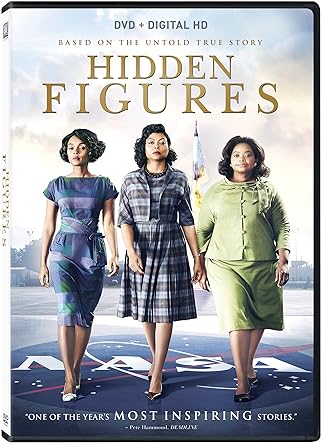
In February, I read and reviewed the book Hidden Figures by Margot Lee Shetterly. The review can be read here. I truly enjoyed the book and have finally seen the movie (about a week ago) based on the same story, also titled Hidden Figures.
Review
The movie begins in 1961at the beginning of the space race when NACA (National Advisory Committee for Aeronautics) becomes NASA (Nation Aeronautics and Space Administration), some years after the start of the book. This is about chapter 16 in Shetterly's book retelling the story of the "colored computers" at Langley Air Base. The movie was full of information about three of the women, Katherine Johnson, Mary Jackson, and Dorthey Vaughan. (I explain more in-depth about them in my book review).

Readers of the book will find that the movie brings the book to life. One situation, in particular, was difficult to imagine, in which Katherine had in finding a "colored" bathroom. She is shown running across the campus carrying her stack of files and work just to simply “relieve” herself. While this was noted in the book it did not sink in until I saw the movie, nd the big scene which her boss made over here being gone for 40 minutes a day. Dorthey is seen seeking advancement which seems hindered at every turn until she looks to the future and becomes the first supervisor for the new IBM machine. Mary appears to have the easiest time, though she is the only one with a legal case to enter the all-white high school building for night classes. The movie made what these women did truly amazing, especially Katherine (who most of the movie is focused on).

Another aspect which impressed me was the way they could do math, the computers where
completing complex calculations in their heads with little assistance from machines, if they had one it was an adding machine. Catherine was shown to be faster and more reliable than the new machine. This was not lost on John Glen when needing last minute calculations done. Matt Blitz (2017) states explains that the scene with Katherine requesting to enter a briefing shows the need of many organizations of the time to break down prejudice. About Stafford’s reply to Katherine of “There’s no protocol for women attending” to which one of Johnson’s most remembered lines of “There’s no protocol for a man circling Earth either, sir.” Blitz says that it “underlines this based-on-a-true-story movie. He is sharing that the quote embodies much of what the movie is about, as well as the story. While this is monumental and easily pointed to, what caught my attention was the respect which John Glen (portrayed by Glen Powell) included the women, especially the African-Americans in the conversation. When the Mercury 7 arrived at the base for training he notices them standing apart
from the crowd and instead of leaving, as the heads want him to, he chooses to go and say hello and shake their hands (specifically Dorothy, Katherine, and Mary), something unheard of in the South at the time. White men did not speak, let alone shake hands, with African-American women, but he did. This brief scene along with a few others shows a contrast in the ideas of north and south. Not all people are bad or stuck in their ways. The movie brought these out more clearly because of the visual elements that text does not convey.

Overall, this is a beautiful example of historic biography. Many of the elements were unknown before and are brining light not only to African-American's at NASA early on but also to women who worked on the numbers. The honor given only to white men for reaching the moon truly belongs to all those who engineered, calculated, and designed during the early years at NACA and NASA.


Hidden Figures Website: http://www.hiddenfigures.com/
On this website, you can find information about both the movie and the book

Search for Hidden Figures Website (Movie Page) https://searchforhiddenfigures.com/the-movie/

20th Century Fox Movie Website

Read others like Hidden Figures

If you enjoyed Hidden Figures Library Journal has compiled a list of other books to read about women in STEM fields and others who overcame great odds to do what they love.

References

20th Century Fox. (2016, August 14). Hidden figures: Teaser trailer [HD] 20th Century FOX [YouTube Video]. Retrieved from https://www.youtube.com/watch?v=RK8xHq6dfAo&index=330&list=WL

Blitz, M. (2017). The true story of ‘Hidden Figures’ and the women who crunched the numbers for NASA: While telling the story of three unknown space heroes, Hidden Figures, also reveals a greater truth about NASA.  Popular Mechanics Goes to the Movies. Retrieved from http://www.popularmechanics.com/space/rockets/a24429/hidden-figures-real-story-nasa-women-computers/

Kundu, S. (2017). Review: Hidden figures [Still Image]. Retrieved from http://standardissuemagazine.com/arts/review-hidden-figures/ 

Shetterly, M. L. (2016). Hidden figures: The American dream and the untold story of the black women mathematicians who helped win the space race. [Kindle Edition]. William Morrow.

Melfi, T. (Director). (2017). Hidden Figures [Motion picture]. United States: 21st Century Fox.


4/14/17

Knuffle Bunny: A Cautionary Tale [Book Review/Information]

Introduction

This is a post I made for a group blog project from my MLIS at SJSU but was unable to use on that particular blog, so  I'm posting it here.

You can find the other blog posts at http://top100childrensbooks.weebly.com/ 
The authors are myself, Julia Christy, Angela Flock, Rachael Parlier, Sarah Zaharako. We worked on the blog for a class project.

So after all that here is my unused post for Knuffle Bunny by Mo Willems.

MO WILLEMS' KNUFFLE BUNNY: A CAUTIONARY TALE


Willems, M. Knuffle Bunny: A Cautionary Tale. Hyperion Books for Children, 2004. 32 pgs. HC $15.99 ISBN 978-0-7868-187-9.

Summary
Trixie and Daddy are running an errand to the laundromat. On the way home Trixie realizes something is wrong, Knuffle Bunny is missing!

Age Range: 3-8 years old

Awards Won: SLJ’s Top 100 Picture Books (2012), Caldecott Honor Book (2005).


Review
Willems provides a story full of action and that many children can relate to. Most children have a cherished toy, that when misplaced causes great distress, just as losing Knuffle Bunny did for Trixie. Publisher’s Weekly (2004) discusses the unique images Willems produces by combining photography and hand-drawn images. They state that “in an innovative style…employs dappled black-and-white photographs of Brooklyn as the backdrop to wickedly funny color cartoons, Willems..creates an entertaining story for parents and children alike” (Publisher's Weekly, 2004). 

Themes
Family
Adventure
Toys
Growing Up

Series Information
KNUFFLE BUNNY
1. Knuffle Bunny: A Cautionary Tale
2. Knuffle Bunny: A Case of Mistaken Identity
3. Knuffle Bunny: A Unexpected Diversion

Application
Teachers, librarians, and parents can use this book to discuss how to handle misunderstandings. As the book is read children can look at the ways in which Daddy, Mommy and Trixie communicate. The book is also a great start to a discussion of children’s favorite toys. For more great applications see the teacher’s guide listed in the Other Resources section (Pigeon Presents, n.d.).

Read-alikes
Crum, S. (20011). Mine! From Good Reads.
Pett, M. (2013). The Boy and the Airplane. From Good Reads.
Raschka, C. (2011). A Ball for Daisy. From Good Reads.


Author Official Website: http://www.mowillems.com/

Other Resources
Knuffle Bunny: Teacher’s Guide http://www.pigeonpresents.com/teachersguides/knuffle_teachguide.pdf

References 

Mayra Cutinhola Figo (User name). (June 7, 2016).  Acting out the story - Knuffle Bunny - 1ยบ ano A [YouTube Video]. Retrieved from https://www.youtube.com/watch?v=z5WzQ9KqsBY

Knuffle Bunny [Cover Image]. (2004). Retrieved from http://www.pigeonpresents.com/book-info.aspx?bid=18

Pigeon Presents. (n.d.) Knuffle bunny: Teacher’s Guide. Hyperion Books for Children. Retrieved from http://www.pigeonpresents.com/teachersguides/knuffle_teachguide.pdf

Publishers Weekly. (2004). Knuffle bunny: A cautionary tale. Retrieved from http://www.publishersweekly.com/978-0-7868-1870-9